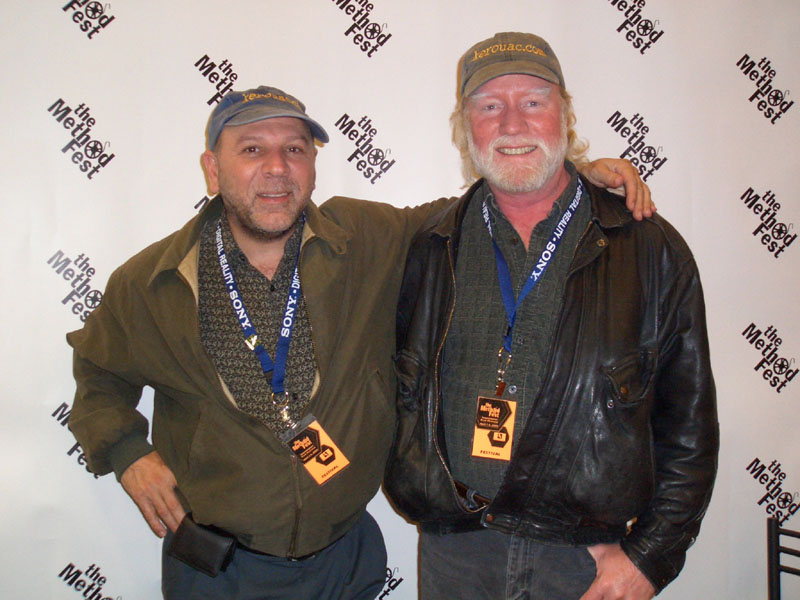
So Long, John Cassady – ole buddy, ole friend…
September 9, 1951 – October 28, 2026
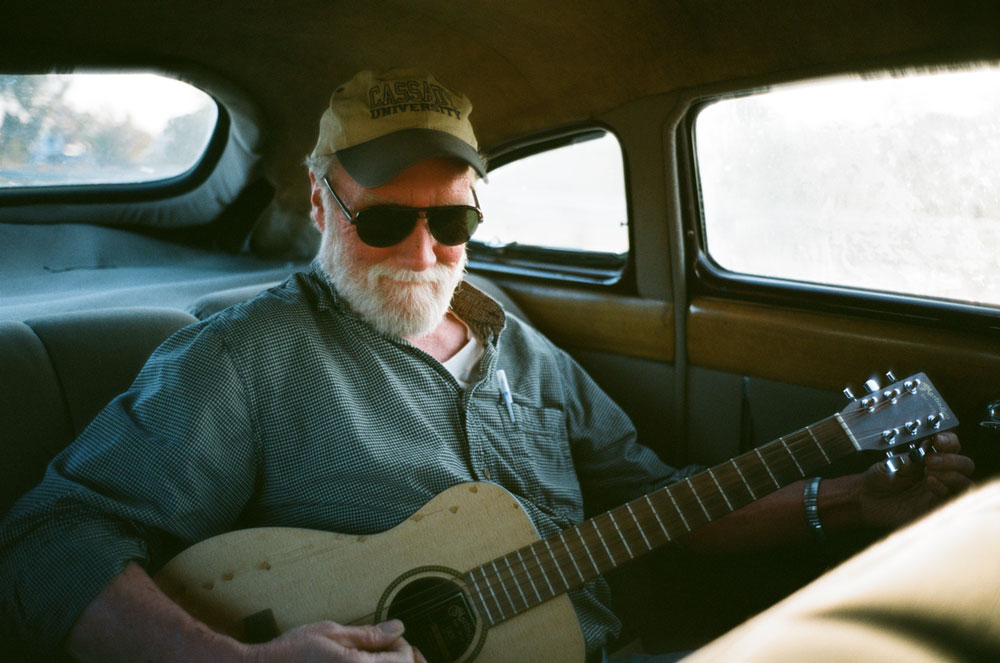
Photo © Gregory Smith)
by Jerry Cimino
Of all of the people I have ever known in my entire life, quite possibly the most unique friendship I have ever formed was with John Allen Cassady.
Photo: Adam Blai
There are a lot of reasons for this. For one, I feel like I met John a full 15 years before I ever laid eyes on him. I was first introduced to him in 1977 as a character in the first Kerouac novel I ever read, Desolation Angels. I don’t remember much about what Jack said about John in that book; I doubt it could have been a whole lot, as John would have only been about five years old. I do recall Jack drawing cartoons for Neal and Carolyn’s children, and John, being the youngest, likely represented the pure innocence of childhood in Jack’s eyes. Later, in Big Sur, when the children were a few years older, Jack calls John “Little Timmy” and describes him as the most brilliant of the three child angels that burst through the door with the golden sunshine at their backs to wake him up at Ferlinghetti’s cabin in Bixby Canyon. As I continued to devour Kerouac, I remember at one point thinking: There’s this guy in California, he’s about my age, and his name is John Allen Cassady. He’s named for his father’s two best friends (Jack & Allen), and Neal Cassady is his dad. Man, what has his life been like compared to mine?
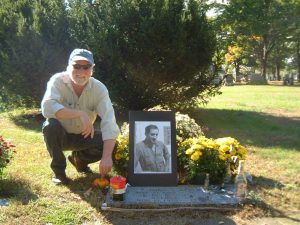
The thing about John, his sisters Cathy and Jami, and Carolyn, too, is that in 1978 they had to be the most famous real-life, everyday American family I had ever heard of, up to that time. Anyone could read about their lives in the books written by their friends and by the various biographers that came along afterward.
Years later, in 1990, when Carolyn Cassady’s book Off the Road was published, I was reunited with John in the pages of another book. But this time, he was a boy growing into a man as seen through the eyes of his mother.
In between, Estelle and I had already moved to California because we’d fallen in love with the Central Coast, particularly Monterey and Big Sur. We arrived in 1988 when I was working for IBM, and I asked for a transfer from Washington, DC. When I got the transfer to San Jose, 3,000 miles closer to Monterey but still a hundred miles away, one of the first neighborhoods Estelle and I checked out was Los Gatos. It was one of the only neighborhoods there we’d ever heard of at the time, because that’s where the Cassady family had lived, and I had read about it in the books. We eventually moved to an area called Almaden, just a few scant miles away.
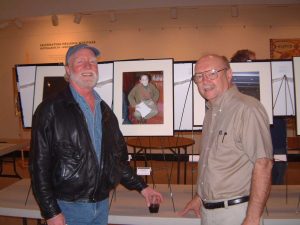
The first time I ever met John in the flesh was 1994. By this point, Estelle and I had moved from the San Jose area to Monterey, and she had started a new business called the Monterey Coffeehouse Bookshop. At one point that year I flew to New York to attend the Beat Generation Conference at NYU. I happened to be sitting in the first row as a session at the conference was about to begin, when a woman sat down next to me, whom I instantly realized was Carolyn Cassady. We exchanged momentary pleasantries as the session began, and when it ended an hour later we introduced ourselves. “Carolyn,” I said, “I know you live in England, and that your kids all still live in the Bay Area, so I imagine you visit California from time to time. My wife owns a bookshop in Monterey. Maybe next time you visit, she can have you in for a book signing.”
“That would be wonderful,” Carolyn said. “My son John lives in San Jose. Here’s his phone number. I’ll be visiting him in a few months. Give him a call and he’ll arrange it.”
So, that’s how I came to know John. Because his mother gave me his number.
A few months later, when it was time for Carolyn’s book signing, John drove her to Monterey. As the event was getting started and Carolyn and Estelle took the stage in front of a hundred people, John said, “I think I need a drink after that drive from San Jose. Is there a bar around here?” “Yeah,” I said, “right across the street. It’s called the Mucky Duck.” So that night I had my first drink with John Allen Cassady. There would be many more.
After that initial meet up, I don’t think I saw John for a year or two.
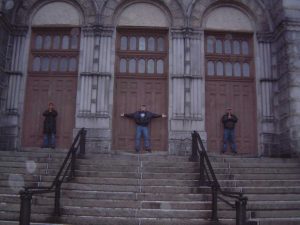
It was through another friend, Steve Edington, whom I’d gotten to know from Lowell Celebrates Kerouac, that I started to see John more regularly. Steve would travel to California, and somehow John and Steve and I would wind up doing things together whenever Steve was in town. We met with Leo Tabory, who was a friend of Neal (he was actually a prison psychiatrist at San Quentin when he met Neal). We’d go to Al Hinkle’s house when Steve was writing articles for Beat Scene and other publications. Al’s daughter, Dawn, whom John had known all his life, would make us all sandwiches as we checked our tape recorders and took notes. Sometimes the three of us would go to Big Sur together, and we’d drive to the Henry Miller Memorial Library or to Ric Masten’s house, a poet who raised his family on a mountaintop in Big Sur, in a house he’d built himself. One time, Steve, John, and I were actually able to make it on to the floor of Bixby Canyon, bypassing the locked gate at the entrance when one of the locals heard Neal’s son (Little Timmy) was anxious to visit Bixby after not having been there since 1961.
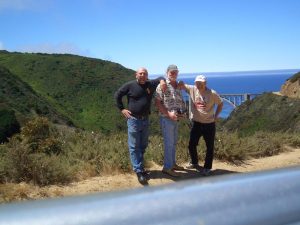
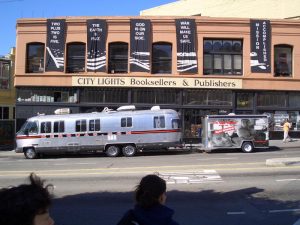
A few more years passed. By this time I had started the Beat Museum in 2003, and soon after had a “vision” while driving behind a huge white bus on I-95, on my way from Lowell to Baltimore. At 3am, in my mind’s eye, I saw emblazoned on the back of that bus while driving through New Jersey these words in bright red lettering: “On the Road with the Beat Museum,” as clear in my imagination as anything I had ever seen in the daylight. Soon I’d purchased an old 1987 Airstream 345 RV, tricked out a 12-foot trailer into a roadworthy bookstore on wheels, and started shopping for gigs on the college circuit. At some point, after not having spoken in a while, John and I caught up to each other and I mentioned my plans. When I asked him what he’d been up to lately he responded, “I just got laid off my high tech job, so I’m sitting around the house eating bonbons and watching Oprah all day long.”
The next day I called John back. “Hey, John, after thinking about yesterday, it occurs to me, I’m ready to embark on this nationwide tour by myself, spreading the gospel of the Beats, and with your name recognition, and the stories you can tell, together we could get a lot more gigs than I’d ever get on my own. Do you think you’d want to team up and try it out for a month or so? If it doesn’t work out you can always fly back home.”
The next day John called me back. “What the hell,” he said. “I’ve got nothing else going on, let’s take a road trip!”
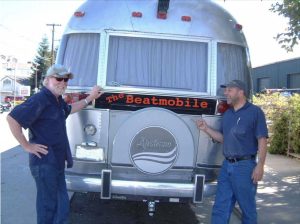
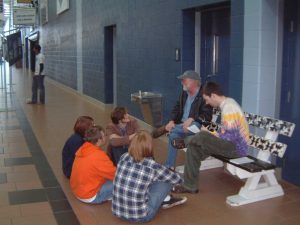
So began our next two years on the road. We drove from California to Maine, to Florida and back. We always took the northern route east and the southern route back. We visited dozens of high schools, colleges, and community centers for three months at a time in 2004 and 2005. Perfect strangers invited us to stay in their homes, and some became lifelong friends. Because I had friends and family all over the East Coast, John met many of my college friends and we even stayed at my brother’s house in Pennsylvania, and later with my parents as well. John was always the perfect houseguest, and even though we were working hard and driving hard (we’d sometimes have to cover 500 miles a day in that 51 foot long monster rig) we were also having a blast. Everywhere we went we were treated like rock stars, John especially. Sometime’s I’d walk back to a classroom after running some errands with some teachers or professors, and there was John with six students sitting in a circle at his feet, regaling them about how Jerry Garcia taught him to play guitar. On stage, John would often riff Van Morrison’s “Moondance” while I’d read Kerouac’s poetry or prose. We really were living a dream in many ways. John would hear my raps and I his stories so many times we could repeat each other’s lines if needed.
We’d have our own little inside jokes:
John, smiling at dinner, as a half dozen professors laughed at his joke: “I’ve got a million of them!”
Jerry: “And some of them are even funny!”
John: “Ah, I get no respect,” doing his best Rodney Dangerfield.
Since we had the same initials, we’d often sign our emails to each other as simply JC.
Sometimes it was JC, “the other one.”
Sometimes it was JC, “the smart one.”
Sometimes it was JC, “the good looking one.”
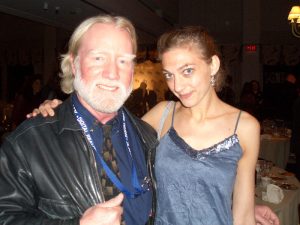
In 2005, I realized if the Beat Museum was ever going to have a chance to be anything, I needed to leave Monterey and take it to San Francisco. I knew we had to be as close to City Lights as possible. John would often come to events. His mother would fly into town, we’d have an event. Kerouac’s scroll was on display at the SF Public Library, we’d have an event. David Amram was on the West Coast, we’d have an event. Garrett Hedlund drove the ’49 Hudson to the Beat Museum, and John and Al Hinkle joined him for the ride up. Oftentimes John would break out his guitar and “Moondance” would waft late into the night.
The thing about John is he was a genuinely nice guy, a good guy, a happy-go-lucky guy. He cared about people, he loved to laugh, and he loved to joke around. He’d often ask a pretty girl to marry him within minutes of meeting her, sometimes in front of her father! “Just for tonight!” he’d say. “Just for tonight!” He also loved to tell stories—and he had a helluva lot of stories.
John also carried a burden like few people I’ve ever known. His name was John Allen Cassady. All three of his namesakes were legendary. He was literally Beat royalty. Wherever we went, people wanted to buy him a drink, they’d want to lay some weed on him, or some other drug. One time we were in a car as a professor drove us to a faculty dinner. At a certain point the professor reached into his breast pocket and flashed a joint. “I’ve been waiting thirty years to say this: ‘Hey, Cassady… want some tea?'”
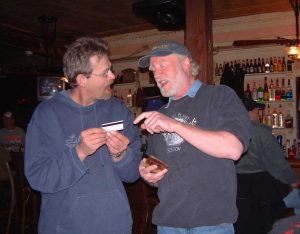
Some people simply wouldn’t believe he was who he said he was. “You’re named after Kerouac, and Ginsberg, and Cassady?” I can’t tell you how many times people asked to see his driver’s license. And then they’d buy us all a drink.
But John carried his obligation with pure grace. I know how hard it is to live up to a father’s reputation. My own father was often considered by the people who knew him as one of the greatest people his friends had ever known. And my father wasn’t famous. Nor did he have two best friends who were also famous.
When I got the news about John the other day, I was extremely saddened, but I wasn’t surprised. Those of us who knew him and loved him knew time was closing in on him. But he was always delightful on the phone calls we shared, always chipper, and never dour. He was glad to talk, to catch up, and to share a joke or two.
John’s sister, Cathy, called me to tell me he didn’t have much time. That I should try to call his son Jamie right away, as I likely wouldn’t have another chance to speak with John. I feel terrible for Cathy because she had lost her sister Jami at the beginning of 2026, and now her brother’s time had come, also in 2026.
I was extremely grateful Cathy alerted me when she did. Three hours later, John was gone. I was told that he didn’t suffer, and went to his maker surrounded by loved ones.
A graceful end for a very good guy.
You will be missed, ole buddy.